
How Charlie Trotter’s audacity transformed the sommelier world
Culinary waves that shaped the way we sell wine today

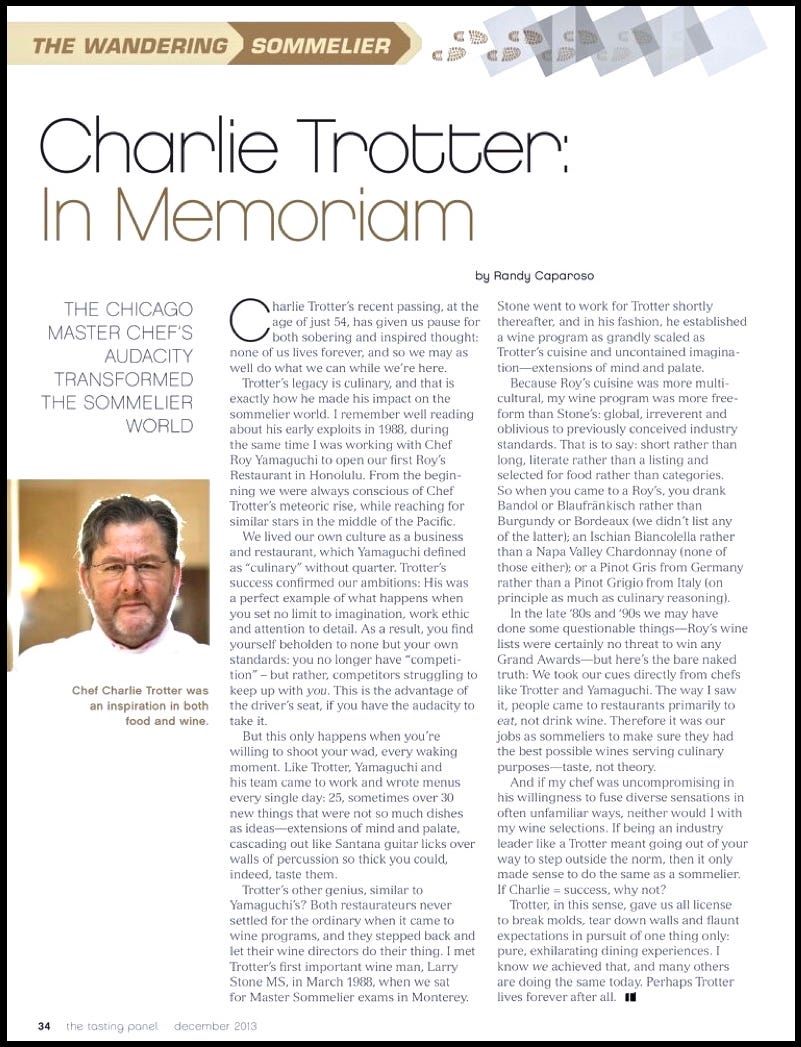
In November of 2013 The Tasting Panel Magazine Publisher Meridith May asked me to write a memoriam to Charlie Trotter, who passed away earlier that month at the age of 54. Way too young.
I didn’t know Trotter personally, but I certainly knew and followed everything he did from practically the moment he burst into the culinary universe. It coincided with everything we did far away in Hawai’i. So naturally, in paying tribute to the career of this culinary wunderkind, I put it in context of his impact on our own work. Everything Trotter did, after all, made giant waves lapping up to the very shores of the Hawaiian Islands.
The thoughts I shared on the ramifications of Chef Trotter:
Charlie Trotter’s recent passing, at the age of just 54, has given us pause for both sobering and inspired thought: None of us live forever, and so we may as well do what we can while we’re here.
Trotter’s legacy is culinary, and that is exactly how he made his impact on the sommelier world. I remember well, reading about his early exploits in 1988, during the same time I was working with Chef Roy Yamaguchi to open our first Roy’s Restaurant in Honolulu. From the beginning we were always conscious of Chef Trotter’s meteoric rise, while reaching for similar stars in the middle of the Pacific.
We lived our own culture as a business and restaurant, which Yamaguchi specifically defined as a “culinary culture,” given without quarter. How we cooked drove our business. Trotter’s success confirmed our ambitions: His was a perfect example of what happens when you set no limit to imagination, work ethic, and attention to detail. As a result, you find yourself beholden to none but your own standards: You no longer have “competition”—but rather, competitors struggling to keep up with you. This is the advantage of being in the driver’s seat, if you have the audacity to take it.
But this only happens when you are willing to shoot your wad, every waking moment. Like Trotter, Yamaguchi and his team came to work and wrote menus every single day; 25, sometimes over 30 new things that were not so much dishes as ideas—extensions of mind and palate, cascading out like Santana guitar licks over walls of percussion so thick you could, indeed, taste them.
Trotter’s other genius, similar to Yamaguchi’s? Both restaurateurs never settled for the ordinary when it came to wine programs, and they stepped back and let their wine directors do their thing. I met and befriended Trotter’s first important wine man, Larry Stone MS, in March 1988, when we sat for Master Sommelier exams in Monterey. Stone went to work for Trotter shortly thereafter; and in his fashion, he established a wine program as grandly scaled as Trotter’s cuisine and uncontained imagination—extensions of mind and palate.

Because Roy’s cuisine was more multi-cultural, my wine program was more free-form than Stone’s: Global, irreverent, and oblivious to previously conceived industry standards. That is to say, short rather than long, literate rather than just a listing, and selected for food rather than the usual requisite categories. So when you came to a Roy’s, you drank Bandol or Blaufränkisch rather than Burgundy or Bordeaux (we didn’t list any of the latter); an Ischian Biancolella rather than a Napa Valley Chardonnay (none of those either); or a Pinot Gris from Germany rather than a Pinot Grigio from Italy (on principle as much as culinary reasoning).
In the late ‘80s and ‘90s we may have done some questionable things—Roy’s wine lists were certainly no threat to win any Grand Awards—but here’s the bare naked truth: We took our cues directly from chefs like Trotter and Yamaguchi. The way I saw it, people came to restaurants primarily to eat, not drink wine. Therefore it was our jobs as sommeliers to make sure they had the best possible wines serving culinary purposes—taste, not theory.
And if my chef was uncompromising in his willingness to fuse diverse sensations in, often, unfamiliar ways, neither would I with my wine selections. If being an industry leader like a Trotter meant going out of your way to step outside the norm, then it only made sense to do the same as a sommelier. If Charlie = success, why not?
Trotter, in this sense, gave us all license to break molds, tear down walls and flaunt expectations in pursuit of one thing only: Pure, exhilarating dining experiences. I know we achieved that, and many others have since been following suit, doing the same things today.
Perhaps Trotter lives forever after all.
Randy, You truly have a way with words. We done! John