

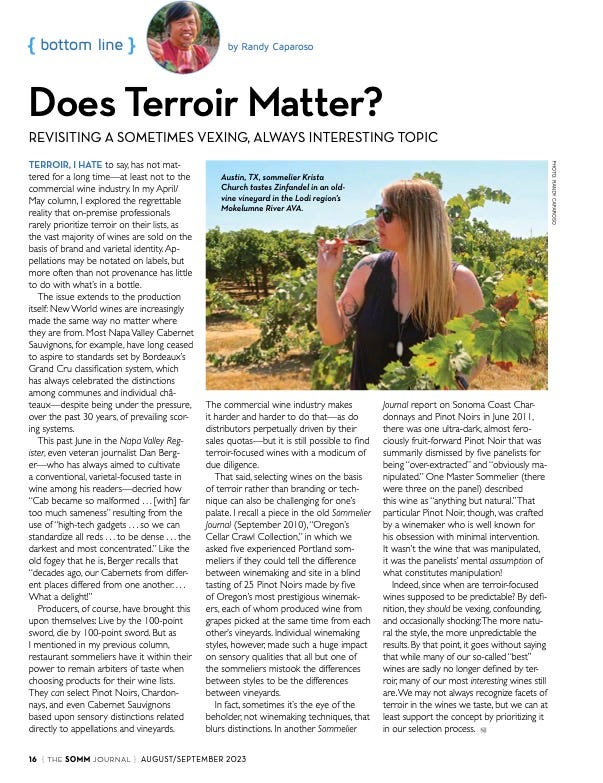
The original text, with slight revisions, of a “Bottom Line” column published in the December 2023 issue of The SOMM Journal.
Terroir, I hate to say, has not mattered for the longest time—at least to much of the commercial wine industry. Instead, the vast majority of wines on the market are sold on the basis of brand and varietal identity. Appellations may be notated on labels, but more often than not provenance has little to do with what’s in a bottle. Wines are made to taste the same no matter where they are from, because conformity to expected taste profiles is how they are judged.
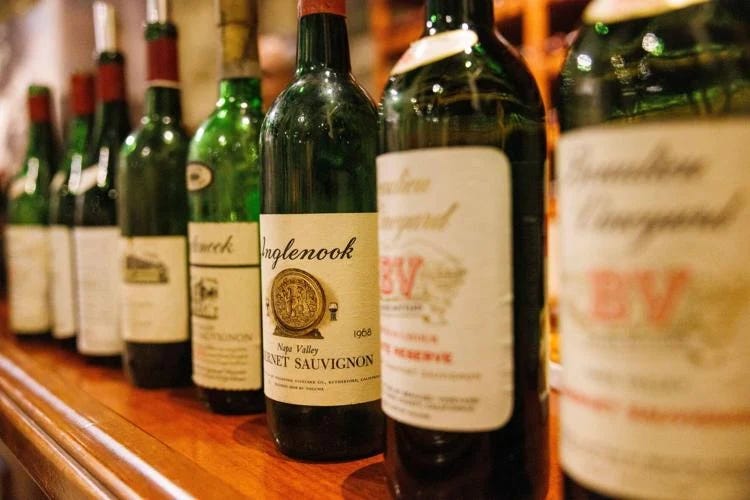
Most Napa Valley Cabernet Sauvignons, for example, have long ceased aspiring to standards set by Bordeaux’s grand crus classification, which has always celebrated sensory distinctions of communes and individual chateaux; even under the pressure, over the past thirty years, of prevailing scoring systems.
But even the wine industry is starting to wonder if this is a good turn of events. In June 2023 in Napa Valley Register, veteran journalist Dan Berger—who has always cultivated a conventional, varietal-focused taste in wine—decried how “Cab became so malformed... far too much sameness” resulting from the use of “high-tech gadgets... so we can standardize all reds... to be dense... the darkest and most concentrated.” Like the old fogey that he is, Berger recalls that “decades ago, our Cabernets from different places differed from one another... what a delight!”
The production industry, of course, has brought this upon itself. Live by the 100-point sword, die by 100-point sword. Restaurant sommeliers, on the other hand, have it within their power to remain arbiters of taste, as well as fashion, when selecting products for their wine lists. They can select Pinot Noirs, Chardonnays and even Cabernet Sauvignons based upon sensory distinctions related directly to appellations and vineyards. The commercial wine industry—and, perpetually, distributors driven by their sales quotas—make it harder and harder to do that, but it is still possible to find terroir-focused wines with a modicum of due diligence.
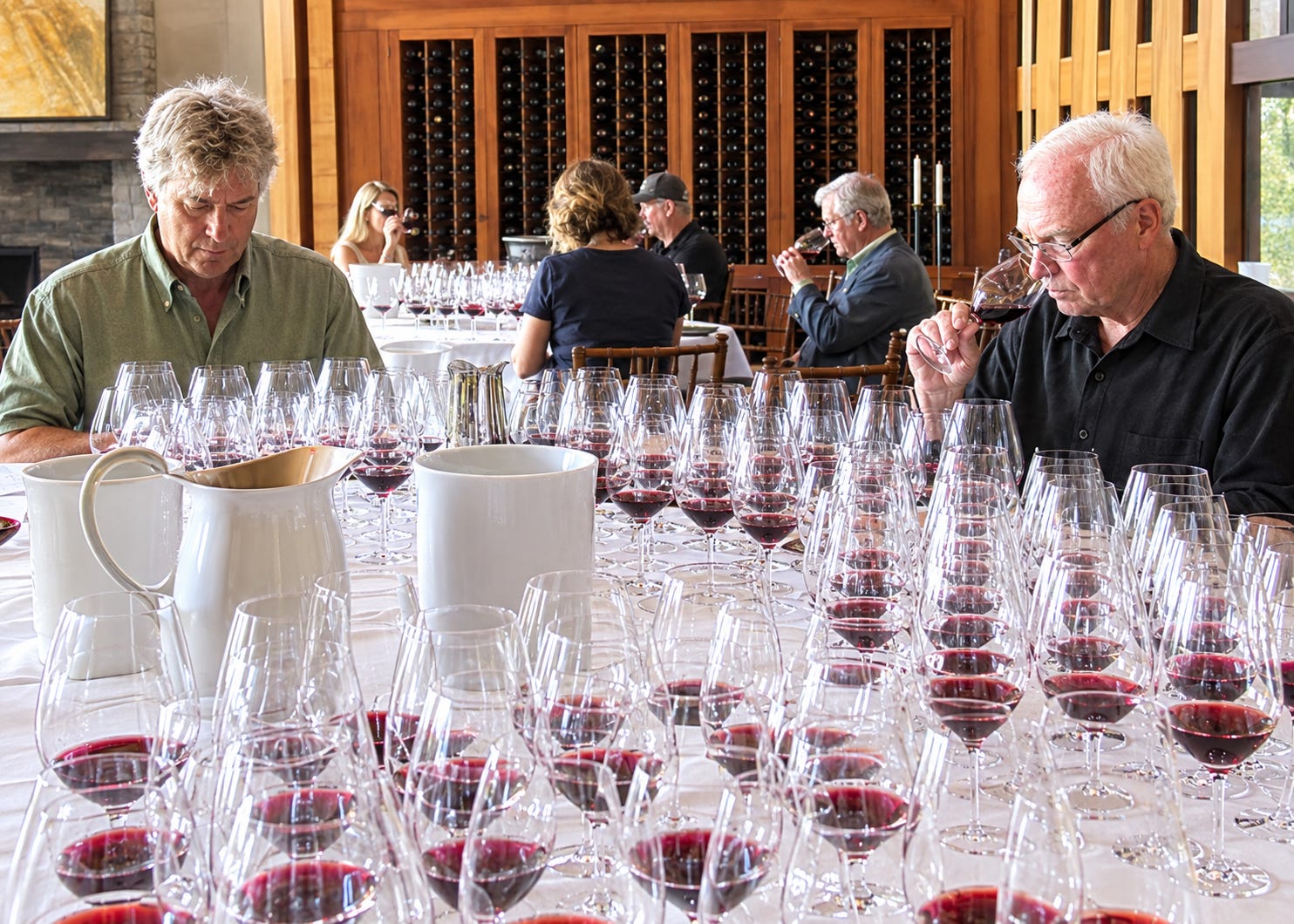
Selecting wines on the basis of terroir rather than branding or techniques, however, can be challenging. I recall a piece put together in the old Sommelier Journal (September 2010) on “Oregon’s Cellar Crawl Collection,” when we asked five experienced Portland sommeliers if they could tell the difference between winemaking and site in a blind tasting of 25 Pinot Noirs made by five of Oregon’s most prestigious winemakers, each producing wine from grapes picked at the same time from each other’s vineyards. Individual winemaking styles, however, made such a huge impact on sensory qualities that only one of the five sommeliers could correctly distinguish vineyards from winemakers.
This was not a failure on the part of the sommeliers. It was a failure on the part of winemakers putting personal style above expression of terroir. Then again, this was back in 2010, when winemaking signatures were still celebrated above all else, and most American consumers could give a damn about sense of place.
Yet sometimes it is not winemaking techniques that blur distinctions, it is the eye of the beholder. In another old Sommelier Journal report on “Sonoma Coast Chardonnays & Pinot Noirs” (June 2011), there was an ultra-dark, almost ferociously fruit-forward Pinot Noir that was summarily dismissed by five panelists for being “over-extracted” and “obviously manipulated.”
One Master Sommelier (there were three of them on this panel) described this wine as “anything but natural.” That particular Pinot Noir, though, was crafted by a winemaker—Ehren Jordan of Failla Wines—who is well known for his obsessive, minimal intervention style winemaking. Jordan wouldn’t dream of “enhancing” color or modifying natural aromas. It wasn’t the wine that was “manipulated,” it was the panelists’ mental assumption of what constitutes manipulation!
Then again, since when are terroir-focused wines supposed to be predictable? By definition, they should be vexing, confounding, occasionally shocking. In fact, the more natural the style, the more unpredictable the results. Sadly, many of our so-called “best” wines are no longer defined by terroir. But many of our most interesting wines still are. We may not always recognize facets of terroir in the wines we taste, but we can at least support the concept by prioritizing it in our selection process.
Nel mondo delle birre artigianali sta iniziando a prendere piede sempre di più il concetto di territorialità delle materie prime: malto d'orzo e luppolo.
Love this, particularly your observation that many of our so-called “best” wines are no longer defined by terroir, while many of our most interesting wines still are.
Perhaps one of the biggest challenges is that the wines considered “best” often follow a predictable commercial formula, while those pursuing something more distinctive leave their makers far more vulnerable. I suppose this is the tension between art and commerce.